
Constructing the Self
A strange kind of creativity.

Performing the Self
I had an interesting conversation with someone when I was a missionary in Oregon. My companion and I were working in the mission office at the time, and it was late at night. If I remember right we had just gotten back from a travel trip to the coast and stopped at the office to charge the cameras and upload the footage we got to the drive—very fun, I know. It was December, and I remember feeling exhausted. We did six exchanges that transfer and I slept in a different apartment for every one of them. I also remember feeling very inadequate and very small. I wasn’t sure how to give other missionaries advice (I had only been out for four-ish months), and my companion was incredible but had a very strong personality; I felt consistently misperceived as quiet or shy or timid and I wasn’t sure how to break that persona, an issue that was amplified because in one sense I was still in training.
Two other sets of missionaries were there at the office that night, and they were both in leadership—we had two sets of assistants in my mission. My companion and I talked to one of the missionaries for a minute about transfer news. We had just talked with all the missionaries in a different zone, so I think we were just asking if he had seen any other needs that we potentially missed, and he gave us a few answers.
We walked back into the other room to move the uploaded footage to the drive, and my companion and I talked about the conversation we had just had. I was telling her how I wished I was able to to know an individual’s specific needs at the drop of a hat like the other missionary had. Was I just not paying attention? Was I not thinking of others enough? Was I not talking to people enough about how they were doing? I felt like I never reached the mark I was supposed to reach.1 I wanted to feel confident as a leader and as a person, but I felt like my inner self was wobbly in that area, especially for those few months in that new zone and assignment. I didn’t know how to maintain consistency in my behavior and personal goals if my well-being and confidence switched so much from day to day.
The other two missionaries overheard our conversation and turned around. Here’s how the conversation went:
“Just so you know, he actually has no idea what is going on in that zone.”
“What?”
“Well let me guess, he told you that ____ needed help, right?”
“Yeah.”
“Well we were just there and he’s doing just fine. He used to struggle a little bit but he doesn’t anymore.”
“Really?”
“Yeah. The AP’s don’t know what’s going on half the time, they’re just respected because they pretend. Like President for example, at zone conference the projector stopped working, and we were running around to fix it, and President said super confidently in front of everyone that the projector was just recalibrating to fit the screen, and everyone believed him. I don’t know why he said that though because projectors don’t actually recalibrate. It was ridiculous. If you want to be a good leader all you have to do is have the appearance of knowing, and you have to be confident in your answers, and everything will be fine.”
The conversation ended there. We drove home to go to bed, and I thought about what he had said for several days. On one hand I was disappointed with the performative nature of leadership in my mission. I wanted to tell people only things that I was sure about. I did not want to pretend to be something I was not—that kind of mindset just ends up disadvantaging everyone. False information abounds and no one gets the help they need. Where was the room for humility, or for mistakes?
On the other hand though, I felt like I had been selling myself short. I had been limiting myself by letting other people take the lead or thinking that my perceived shortcomings made me less capable than others. Was there a way I could think about my room for growth that was more settled? Was there a way that I could worry more about being my best self and worry less about if my best self was stepping on someone’s toes? I didn’t want to be overbearing, but I also didn’t want to put myself in a box, and it felt like there was a delicate line to walk between the two. In some ways it made sense to practice being the kind of person I hoped to be or wanted to be, even if I didn’t feel that way within myself.
My Reality ≠ Someone Else’s Reality
After this conversation on my mission, I remember thinking back to an experience I had in high school.
I was dating a boy, and his twin sister’s best friend posted something hurtful on her social media about me. I remember never having felt so small or so low in my entire life—at least never in such a public way. It felt a little bit like I had been turned inside out for everyone to laugh at and make fun of my vulnerabilities. I broke up with the guy and my mental and physical health crashed for several months.
Everything’s fine now, obviously. I’m on good terms with most everyone involved, and it was a long time ago. If the same thing happened now I likely wouldn’t care—I probably wouldn’t even see it to be honest. I bring it up because it was a formative experience for me in realizing how I allow other people’s perceptions of me to make me feel about myself. It’s probably a lesson that I will continue to learn through my adult life.
Constructing the Narrative
There’s a lot more to this story, with many missteps on my end, but it took me a long time to get better. It took a massive amount of energy to build my self-trust up to a place where I could tell myself something positive about myself and believe it. It took another leap to get to a place where I was an autonomous person again—less connected to the opinions and misjudgments of others.
I remember the month I started to feel normal again, and part of the process was learning to see my perceived flaws as strengths. I realized that I know me better than anyone else does, and the things other people thought or said about me did not have to matter. There is a subjectivity to the narrative we tell ourselves. I realized I had the power to lean into certain thoughts more than others. Because my reality was fluid with many different interpretations, I did not have to fit my thoughts or self into the lazy boxes that other people had created relating to me. In some ways, I could mold reality to fit me.
I see something similar in academia all the time. My professors are experts in their fields. Every one of them has spent 10-12 years in higher education doing intensive research on whatever it is they teach. Most of them have worked as professors for many years. They know what they’re talking about. At the same time though, there’s still a necessary level of confidence one needs to have in order to draw conclusions about something. No matter how much education you have, you still have to be the one to construct the narrative of how you got from point A to point B, and the narrative doesn’t exist as an independent concept for you to find, it is created along the way. People go to school to learn how to think in a way that they are capable of constructing the narrative. The thing with intellectuals is that often an idea has value to them because they attribute value to it. Nothing is as concrete as it seems.
Fighting the Self to Create the Self
I do feel that the narratives we construct about ourselves matter. It takes courage and character to create something that you are proud of. It is also painful and challenging to fight the self in order to create the self—everyone knows this.
I am not my thoughts. I am not my thoughts. I am not my thoughts. But at the same time, my thoughts construct my reality. When is it important to disregard a thought, and when is it important to pay attention to one?
I think about Tolstoy’s Anna Karenina all the time (spoilers ahead). Just as we can create a positive reality by leaning into positive thoughts, we can also create a negative reality by leaning into destructive thoughts. Anna chooses to live out a fantasy by having an affair with Count Vronsky, only to spiral out of control in her worries that Vronsky no longer loves her (even though he reassures her over and over again that he does). Near the end of the novel, Anna has betrayed everyone in her life only to ruin her new life—the one with Vronsky—with her paranoia. Anna commits suicide, and there is a moment where the gap between reality and her perception of reality is revealed, only it’s too late for her to merge the two. I’ve italicized where this is most obvious.2
“She tried to fling herself below the wheels of the first carriage as it reached her…A feeling such as she had known when about to take the first plunge in bathing came upon her, and she crossed herself. That familiar gesture brought back into her soul a whole series of girlish and childish memories, and suddenly the darkness that had covered everything for her was torn apart, and life rose up before her for an instant with all its bright past joys. But she did not take her eyes from the wheels of the second carriage… And at the same instant she was terror-stricken at what she was doing. "Where am I? What am I doing? What for?" She tried to get up, to drop backwards; but something huge and merciless struck her on the head and rolled her on her back. "Lord, forgive me all!" she said, feeling it impossible to struggle. A peasant muttering something was working at the iron above her. And the light by which she had read the book filled with troubles, falsehoods, sorrow, and evil, flared up more brightly than ever before, lighted up for her all that had been in darkness, flickered, began to grow dim, and was quenched forever.”
What would have happened to Anna if she had been able to merge reality and her perception of reality, if she had been able to construct a more positive narrative for herself? Would she be able to move forward in the new life she had chosen? Would she be able to accept the losses of her previous life, her son and her husband? Even though she had destroyed one possibility, the second option did not have to end the way it did.
The Fluidity of the Self
I guess my point is that it is both taxing and necessary to shape reality to yourself. The person who can do this throughout their life has a mental tenacity that I find so powerful.
I don’t mean that we should lie to ourselves or maintain illusions about our own reality, good or bad. But I think it is important to be mentally strong, and to recognize that there are some things that we have control over in terms of our self-perception and how we deal with the perceptions of others. There’s always going to be a gap between the wobbly inner self and the ideal self that exists somewhere in the amorphous future. We get to choose how to respond to the gap. Instead of putting energy into creating negative narratives, I can put an equal amount of energy into creating positive ones.
It’s true that my self changes on the day to day. Sometimes I make mistakes. Sometimes I struggle maintaining positive thoughts more than other times. Sometimes I don’t believe the things I say to myself (this is the worst kind). It’s not necessarily a matter of progress;3 these things are organic. They ebb and flow. It is, on the other hand, a matter of health and stability and creativity. The ability to create a life, to shape the way you see yourself and the world and others, to pursue new experiences, to look forward to the future, to perform your ideal self even when you don’t feel it, is a gift.
I love this quote from Tanya Luhrmann, a professor from the University of Chicago who said this in her Aims address to the class of 2007.
“Many young Americans think that to know themselves they need to find themselves, and they hold the naive belief that if they could just strip off everyday life like layers of an onion they would reach their true core, unadulterated by other people’s expectations and the distractions of a fast-paced world. They believe that they have a true core, an essence, and that it sits inside of them waiting to be discovered, and that once they find it they will know whether they ought to be a doctor or a lawyer or a philosophy professor. Sometimes these young people go to Europe and work their way through Mediterranean countries picking grapes, confident that their true self will emerge somewhere en route to Italy. But people who believe that the self is like an onion and their true self is its core have not spent much time in the kitchen. Peel an onion down to its core and all you will find is air. You are not an untouched core. You are and will become the sum of your commitments, your choices—moral, intellectual, and practical—they amount to much the same thing in the end. To find yourself, don’t dig under the surface of your life. Look at what you actually do, at what you come to care for, at what you fight to defend. Look at the small choices you make every day in the classroom, in the way that you read and interpret and argue, and the big choices will sort themselves out by themselves.”
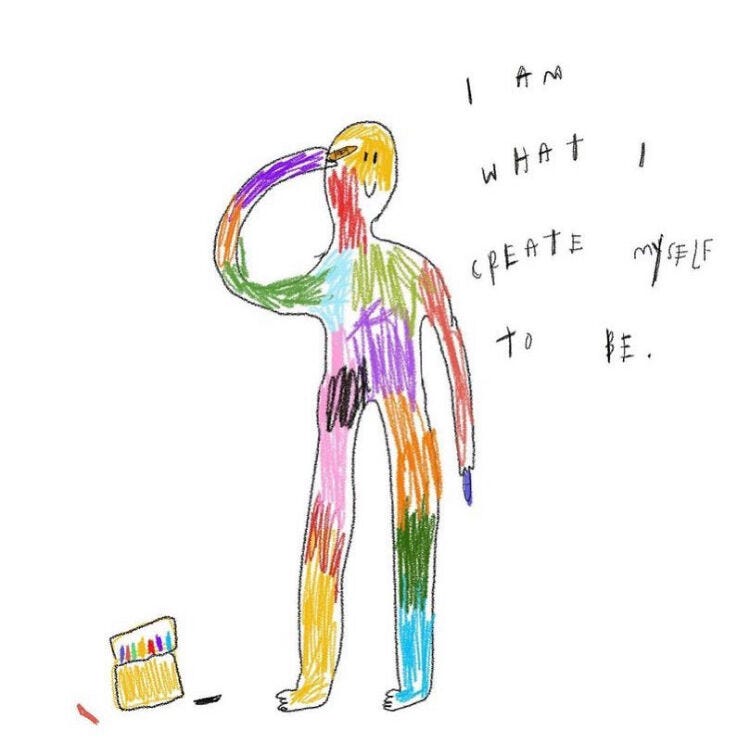
So you don’t “find yourself.” You actively create the self every day with your actions. It is not consistent, but it’s magic! It’s new all the time. It’s incredible that we can be always reaching and yet still whole.
A last thought
Even when I am inconsistent and unstable and insecure, God is not. People ebb and flow. They sometimes get better without actually getting well. They make the same mistake over and over again. It helps me to know that God is working alongside me in creation, and He is unchangeable. He is the “fixed foot” of the compass in John Donne’s “A Valediction Forbidding Mourning” that “though it in the center sit,/Yet when the other far doth roam,/It leans and hearkens after it.” I think He loves to watch us live and realize who we are.
Things did eventually feel more natural on my mission. I did step into my role, however imperfectly, and there were moments where I pretended to be more self-assured than I felt. It was a helpful skill for me to practice, because really none of us know what we are doing. All life requires of us is to try.
“And now, my sons, remember, remember that it is upon the rock of our Redeemer, who is Christ, the Son of God, that ye must build your foundation; that when the devil shall send forth his mighty winds, yea, his shafts in the whirlwind, yea, when all his hail and his mighty storm shall beat upon you, it shall have no power over you to drag you down to the gulf of misery and endless wo, because of the rock upon which ye are built, which is a sure foundation, a foundation whereon if men build they cannot fall.”
No one ever reaches it. It just keeps moving, and that’s the beauty of life. To learn is to consistently not know. A growth-minded person gets used to this feeling in order to progress. It is better to lean into curiosity and hopefulness than frustration.
Just as a side note: This is a pivotal scene in one of the best-written novels of all time. The writing here is absolutely stunning, and I have yet to read anything quite like Anna Karenina. So compassionate and complex and perfectamazingincredible. Woooo! The Russian classics are something else.
It is about progress though even as mental health ebbs and flows. Sometimes it’s about raising the base level slowly so you fall less and less every time. Sometimes it’s about recovering from a crash and burn moment. Either way takes a lot of work. Existing in general takes work, haha.